
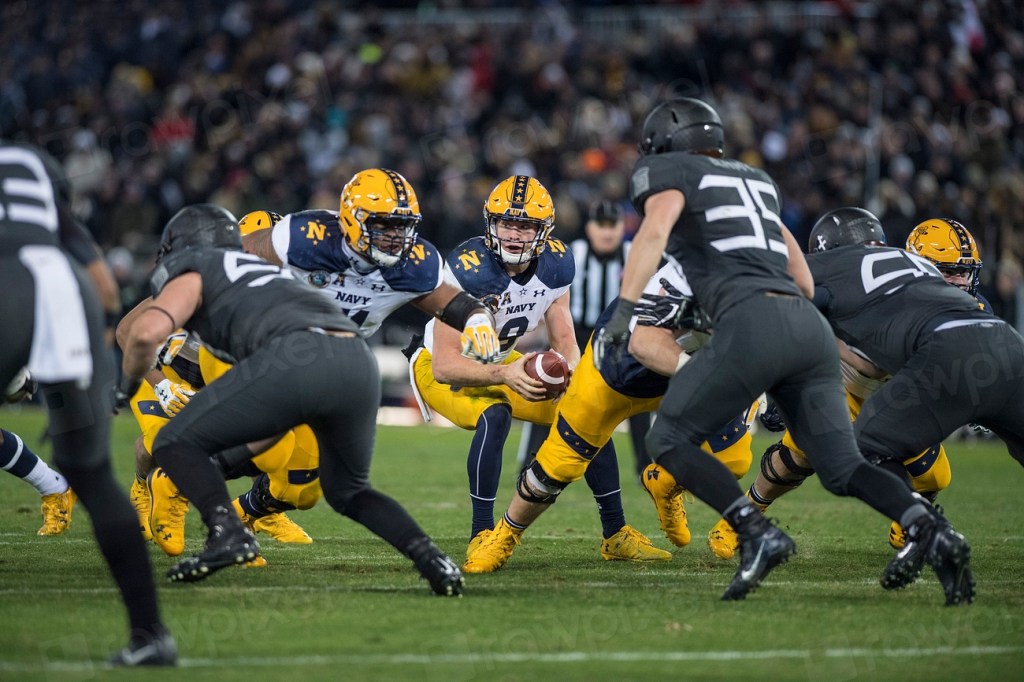

Rivalries are the lifeblood of college football. There is nothing better than beating your rival, and nothing worse than losing to them. Rivalries are as integral to the sport as helmets, shoulder pads, and goal posts. Many teams have been playing–and hating–one another since before the first World War. Many rivalry games are situated on the same weekend each season, such as the “Third Saturday in October” or the entirety of Thanksgiving weekend. There is one major rivalry game that has its’ own unique window as the only game in town.
Army-Navy Game
Army-Navy is a rivalry unlike any other in college football. The service academies are unique to the sport because of the service obligations, the height/weight restrictions, and the traditions associated with each of the three schools. The Commander-in-Chief’s Trophy is awarded each year to either Army, Navy, or Air Force. All three academies play one another each season. Often, the Army-Navy game, played annually on the second Saturday in December, is a match-up to decide who takes home the Trophy.

For Army and Navy, the one thing more important than winning the CIC is beating one another. There is great pain and misery that accompanies the loser of this game, knowing they will have to wait an entire year at a chance for revenge. Sometimes, the wait is much longer.
From 2002 to 2015, Navy beat Army 14 consecutive times. One can only imagine the anguish felt in West Point, New York after each successive defeat. “What’s wrong with us? How can we keep losing to these guys? Is this ever going to end?” After a decade and a half of Naval superiority, what could be done to turn the tide in the rivalry? All of those questions were answered on December 10th, 2016, at M&T Bank Stadium in Baltimore, Maryland. Before we get to that, here is some background on the rivalry.
Rivalry History
The Army-Navy game has been played almost every year since 1890. Navy won the first contest 24-0 in West Point. One year later, Army won 32-16 in Annapolis, Maryland. Overall, the Midshipmen lead the series over the Black Knights 64-55-7. This rivalry, like many others, has been streaky at times. From 1913 to 1933, Navy only managed three wins in the series. From 1950 to 1963, Army only won the game three times. The Midshipmen went 9-1-1 against the Black Knights from 1973 to 1983. From 1984 to 2001, Army held the advantage in the rivalry, going 12-6, including a five game win streak from 1992 to 1996.
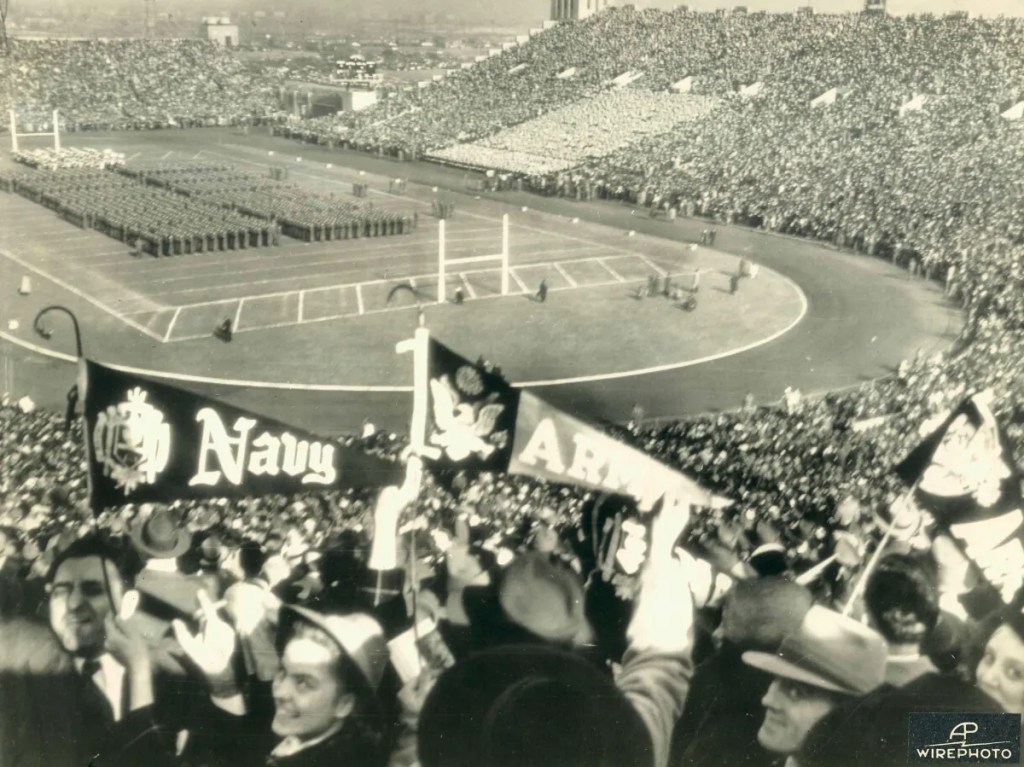
The turn of the century marked a new age in America’s game. New Navy head coach Paul Johnson, by way of Georgia Southern, led a lethal triple option attack and went 6-0 against Army from 2002 to 2007. Johnson’s teams beat Army by an average score of 40-12. In 2008, after Johnson left for Georgia Tech, his former offensive assistant Ken Niumatalolo became his successor in Annapolis. Niumatalolo won his first eight match-ups against the Black Knights from 2008 to 2015. In those games, the Midshipmen won by an average of 14 points.

In 2014, Army hired Jeff Monken–another Paul Johnson assistant–away from Georgia Southern. Monken went 6-18 in his first two seasons in West Point, and lost his first two games against the Midshipmen. Army fought hard in those games, losing each by a single score. Navy kept right on humming after the departure of Paul Johnson, as Niumatalolo won eight or more games in seven of eight seasons from 2008 to 2015. Navy went 11-2 in 2015 and finished ranked No. 18 in the AP Poll.
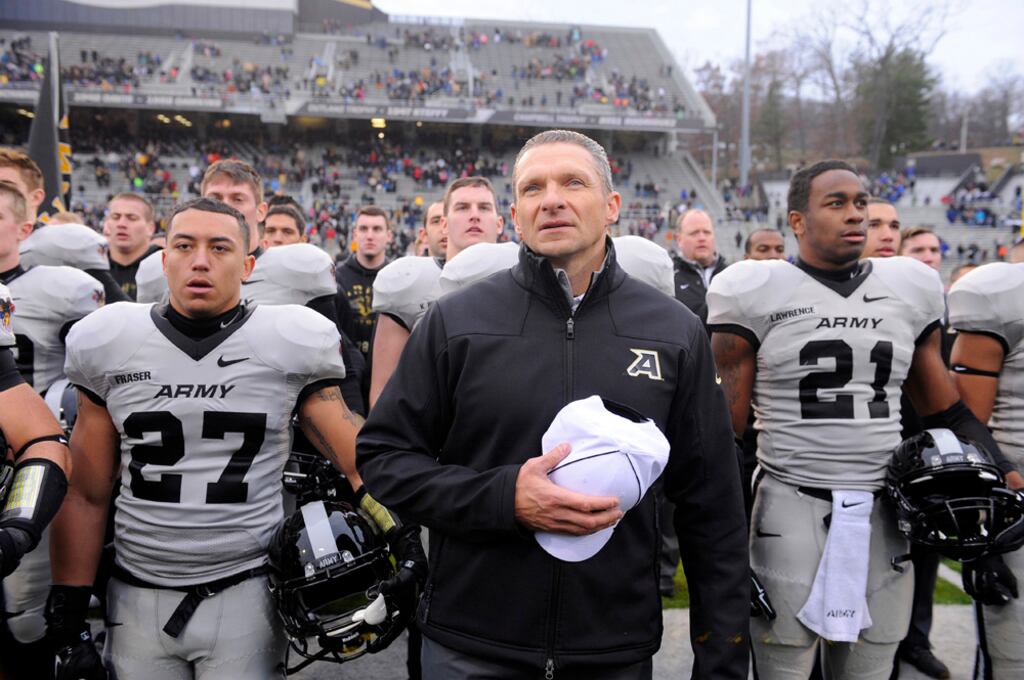
In Monken’s third season in command, Army had turned a corner. Coming into the match-up with Navy, the Black Knights had won 6 games, the most by an Army team since 2010, and the second most since 1996. Navy entered the game at 9-3, with wins over Notre Dame and No. 6 Houston. The Mids also destroyed SMU in Dallas, 75-31. Navy lost in the American Championship Game to the Temple Owls the week before the match-up with Army, but were still poised to continue the streak over their arch rivals.
Navy
Navy lost more than the American Championship against Temple; they also lost their starting quarterback to injury. Senior QB Will Worth had replaced starting QB Tago Smith in the second quarter of week 1, after Smith suffered an injury. Worth went down late in the first half of the title game against the Owls. The Midshipmen called up sophomore Zach Abey, who started the year as the third-stringer behind Smith and Worth. Abey’s first-ever collegiate start coincided with the biggest game of Navy’s season.

Joining Abey in the Navy backfield were tailbacks Toneo Gulley and Dishan Romine, along with fullbacks Chris High and Shawn White. The Midshipmen finished 2016 fourth in the nation in rushing, averaging 311 yards per game. Wide receiver Jamir Tillman was a threat on the outside, with respect to service academy passing standards. Tillman finished the year with over 600 receiving yards and two touchdown receptions.
The Midshipmen struggled defensively prior to the game against the Black Knights, giving up over 30 points per game. Navy was more susceptible through the air than on the ground, giving up nearly 260 yards passing to opposing teams. Fortunately for them, Army was not going to be airing the ball out much at all.
Army
Monken’s Black Knights were second in the country in rushing, at over 330 yards per game. Quarterback Ahmad Bradshaw led the attack for Army. He was putrid as a passer, completing less than 45% of his throws, with double the amount of interceptions as touchdowns. But he was lethal as a runner in the triple option scheme. Joining Bradshaw were backs Andy Davidson, Tyler Campbell, Kell Walker, and Jordan Asberry. The Black Knights top receiver was Edgar Allen Poe, Jr., who averaged over 20 yards per reception.

The Army defense was stifling. They were allowing only 19 points per game, and ranked in the top 20 in both passing and rushing defense, while ranking in the top 5 in total defense. The game against the Midshipmen, as it so often does, would come down to stopping the run and forcing mistakes.
First Half
Army forced that first mistake on Navy’s opening drive. Black Knights’ senior safety Xavier Moss forced a Shawn White fumble five plays in. Army took over and marched downfield on a 14-play, 66-yard drive capped by Davidson’s 10th rushing touchdown of the season. The Black Knights drew first blood with less than 5 minutes remaining in the first quarter. On Navy’s ensuing possession, Abey threw an ill-advised pass deep downfield into double coverage intended for Tillman. Moss came up big again, intercepting the ball near the Army 30-yard line.
Army took over and moved the chains twice after strong runs from Walker and Davidson. On second-down and long, Bradshaw gave the Midshipmen the ball back. His play-action pass was intercepted by Navy safety Sean Williams deep in Navy territory with less than 30 seconds remaining in the opening period.
Navy went three-and-out, and capped off the drive with a dreadful, 15-yard punt. Army took over at the Navy 46-yard line. Bradshaw and company found the promised land after running 11-plays and holding the ball for over six minutes. The drive featured a heavy dose of Davidson and Walker, with Campbell and Bradshaw each running for a yard. Davidson’s three-yard carry on fourth-and-two kept the drive going. He was rewarded two plays later with a 1-yard TD rush, his second of the game. Army was in command 14-0 halfway through the second quarter.
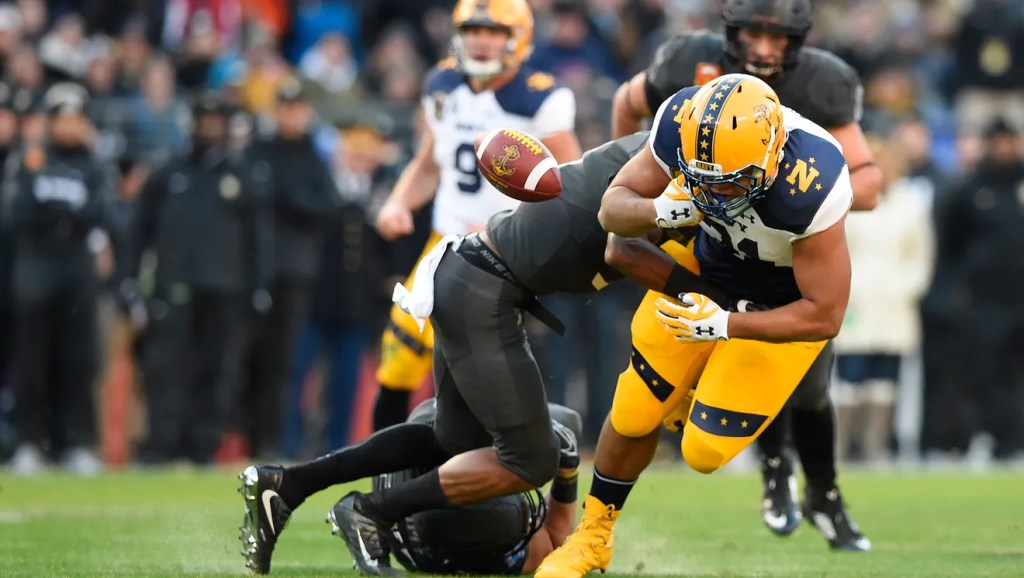
Navy’s ensuing drive went three-and-out, only this time finishing with a much better punt from Alex Barta. The Black Knights took over inside their own 15-yard line. After impressive runs from Asberry and Walker got Army across midfield, the Black Knights turned it over for a second time. Davidson was stuffed and stripped at the line by Navy defensive end Tyler Sayles, while fellow Mids’ defensive lineman Amos Mason recovered the fumble.
The Mids took over with over a minute remaining and good field position. Unfortunately, Abey gave the ball right back to the Black Knights on the very next play, throwing his second interception of the day. Defensive back Rhyan England picked off the pass intended for Calvin Cass, Jr. Army ran out the clock and took the 14-0 lead into the locker room.
Second Half
The tides turned in the Midshipmen’s favor quickly in the third quarter, as Navy defenders forced a Bradshaw fumble on the second play from scrimmage. The Mids took over at the Army 32-yard line. Shawn White picked up 16-yards on a perfectly executed third-down screen pass from Abey to get Navy down near the 10-yard line. Two plays later, Navy got on the board as Abey punched it in the end zone from a yard out. Army held a 14-7 lead, but Navy had all the momentum.
Army went three-and-out on their next drive, punting for the first time in the game. Navy took over at their own 35-yard line. Abey hit tight end Brandon Colon for a huge 29-yard pick-up on second down. Two plays later, Abey connected with a first down to Tillman. After four more rushes from Abey, the Mids’ settled for three points from the Army 11-yard line. Kicker Bennett Moehring split the uprights to cut the Black Knights lead to 14-10 with under four minutes remaining in the third quarter.
Army was moving the chains after big rushes from Campbell and Walker before yet another massive turnover drew the feeling of impending doom from Black Knights’ fans everywhere. On second-and-six from the Navy 38-yard line, Davidson was stripped again, and Williams recovered the ball for Navy with 1:22 remaining in the third period. The two teams traded three-and-outs and punts on each of their next drives.
Early in the fourth quarter, Navy finally took the lead. After taking over at their own 47-yard line following a poor Army punt, Abey hit Tillman for 12-yards and a first down. On the next play, Abey broke five tackles on an electrifying run as he took the ball 41-yards for the go-ahead score. The Mids led 17-14 with 12:42 left in the ball game.

After Army took over at their own 20-yard line, Bradshaw completed his biggest pass of the night. After faking the toss, he connected with Edgar Allen Poe, Jr. for 29-yards to get the Black Knights near midfield. Davidson and Woolfolk got Army another first down to the Navy 40-yard line. Bradshaw converted a third-down to get to the Navy 27. After a nifty shovel pass got the Black Knights 6-yards on third-and-seven, Monken sent his offense out on fourth-and-1 from the Mids’ 18-yard line.
Despite two huge fumbles earlier in the game, Davidson’s number was called during the game’s most important play. He picked up seven yards to move the chains and set Army up with a first down and a chance to take the lead. Two plays later, Bradshaw took it in from 9-yards out to give the Black Knights a 21-17 advantage with six minutes remaining in the fourth quarter.
A big sack on Abey on the Mids’ ensuing possession disrupted the drive. Army’s defense tightened up and forced Navy to punt. The Black Knights took over at their own 23-yard line with less than four minutes remaining in the game. Tyler Campbell rushed for 11-yards, while Woolfolk and Davidson combined for another 10. On third-and-1 from the Army 45, with 1:45 to go, Bradshaw converted the first down and put the nail in Navy’s coffin. The Black Knights ran out the clock, and at long last, the streak was over.
Post Game
Both teams had crucial turnovers in this game. Both quarterbacks struggled at times. Each defense made some big stops in key moments. But, the Black Knights were victorious because of one reason: their punishing rushing attack. Army ran 74 plays to Navy’s 36. That almost seems impossible in a game between service academies. The Black Knights rushed for 316 yards on 70 carries. The two teams combined for 124 passing yards, which actually seems a little high.

Navy could not get consistent stops on Monken’s triple option attack, as Army went 10 of 15 on third and fourth down. Despite losing three fumbles, Monken kept trusting his guys to deliver when it mattered; and they did. Walker rushed for 94 yards while Davidson finished with 87. Bradshaw was the third-leading rusher with 51 yards on nine carries, while Woolfolk, Campbell, and Asberry provided timely, meaningful rushes of their own. Bradshaw only completed two passes, but the 29-yarder to Poe, Jr. on the eventual game-winning drive was all he needed.
Abey performed admirably, given the unenviable position that he was put in. He finished 6 of 10 passing, with two very nicely designed throws on Navy’s scoring drives. His go-ahead touchdown run in the fourth quarter showed his athletic ability and heart. The Navy offense was simply not good enough. Running backs White and High combined for just 39 yards on 7 carries. If you take out Abey’s 41-yard scoring run, the Mids averaged just 2.8 yards per rush for the game.

All of these factors led to Army singing second for the first time since 2001. It was also the first win for the Black Knights in Baltimore since 1944. Interesting note about the 2001 match-up: it was the most-watched college football game from 2000-2010. Army finished 3-8 that season, Navy was 0-10.

Aftermath
There were 5,488 days between Army victories over Navy. For fans, it may as well have been 10,000 days. Monken’s team had finally overcome the hurdle of winning the most important game of the year. For Niumatalolo, the result was a gut punch. Not only had he lost to his rival for the first time as head coach, but it was in the midst of a three game losing streak. Navy’s strong season went off the rails at the end, culminating in a 9-5 finish after a 9-2 start. The Mids lost the Armed Forces Bowl 48-45 to Louisiana Tech while Army beat North Texas in the Heart of Dallas Bowl 38-31 to finish 8-5.
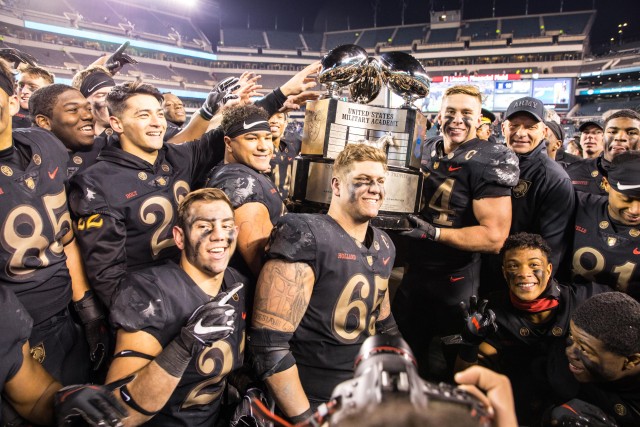
The win over Navy was the spark to Monken’s Black Knights’ massive improvement over the next several years. Army went 21-5 in 2017 and 2018, including a 4-0 record against Air Force and Navy. The Black Knights took home the CIC Trophy both years, won two bowl games, and nearly stunned Oklahoma in Norman in 2018.
Navy’s next victory over the Black Knights would come in 2019. Coming off a dreadful 2018 campaign where they finished 3-10, the Mids pummeled Army 31-7. Navy finished 2019 with an 11-2 record and a No. 20 ranking in the AP Poll. That same season, Air Force finished 11-2, ranked No. 22. It would the first season that two service academies finished a season ranked in the AP Poll since 1958, when Army finished 3rd and Air Force finished 6th.


Leave a Reply