

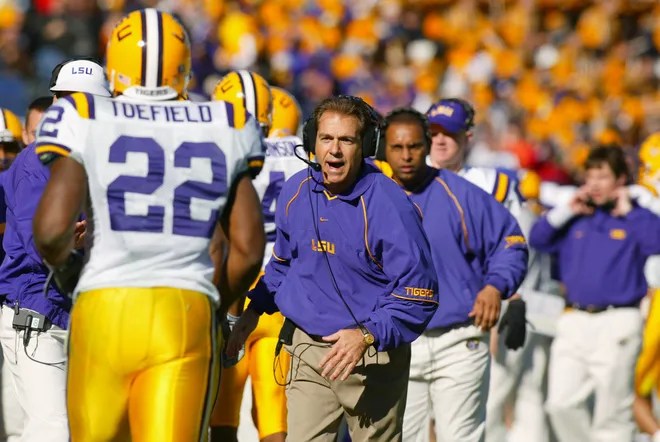
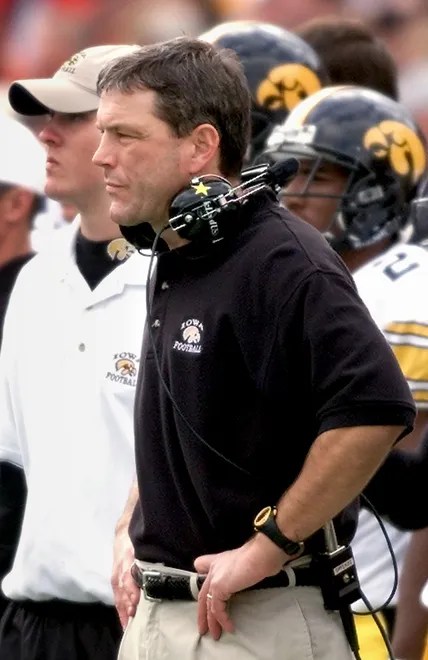
On this installment of our bowl game bonanza, we’re going to play a little game that I like to call: “name some dudes”. When Iowa and LSU faced off on New Year’s Day 2005 in Orlando, Florida, there were plenty of dudes present. The coaches included Nick Saban, Will Muschamp, Jimbo Fisher, Kirby Smart, and Derek Dooley. Those were just the polos on the LSU sideline. Across the field, Iowa legend Kirk Ferentz was in his sixth season, while his present-day defensive coordinator Phil Parker was coaching up the defensive secondary.
Prior to the game, Saban had already made known his plans to leave LSU to take the Miami Dolphins head coaching job. One year after winning a national championship with the Tigers, Saban left the college ranks to pursue success in the NFL. One can only assume he had incredible success in South Beach. The 2004 season was a bit of a disappointment to the Bayou Bengals faithful, as LSU came into bowl season at 9-2, ranked No. 12. A heartbreaking 10-9 defeat on the road at Auburn and a lifeless drubbing from Georgia were the only blemishes on the record, and they both happened early in the year. Unlike in the College Football Playoff era, back in 2004, two regular season losses essentially destroyed any national championship hopes.
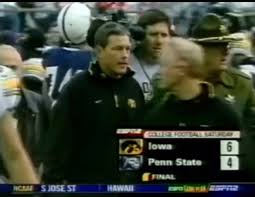
Iowa, ranked No. 11 in the nation, was also 9-2. The Hawkeyes had also suffered their two losses very early in the season. They won seven in a row to end the regular season, undoubtedly inspired by their thrilling 6-4 road victory against Penn State in late-October. The Hawks’ 7-1 record in Big Ten conference play was good enough for a split conference title with the Michigan Wolverines. Michigan was responsible for Iowa’s only conference loss.
More Dudes
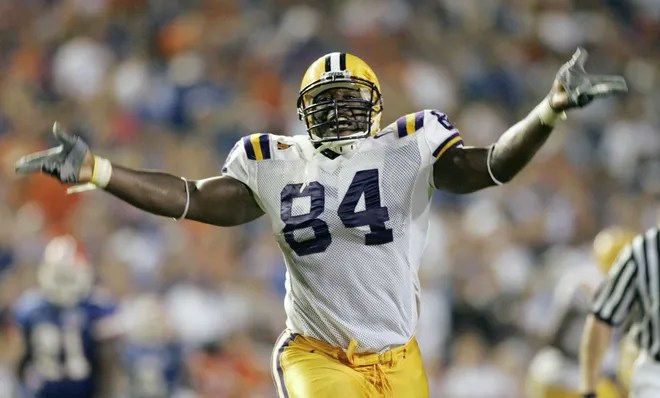
LSU had both Matt Flynn and JaMarcus Russell at quarterback, and both backed up the starter Marcus Randall. In the backfield with Randall were Joseph Addai and Alley Broussard. The receiving corps included Early Doucet, Craig Davis, Skyler Green and Dwayne Bowe. The offensive line was anchored by Andrew Whitworth. The defense was full of future NFL talent, including All-American defensive end Marcus Spears and an all-world cornerback tandem of Travis Daniels and Corey Webster. LaRon Landry was an All-SEC safety who grew into a top-ten NFL Draft pick.
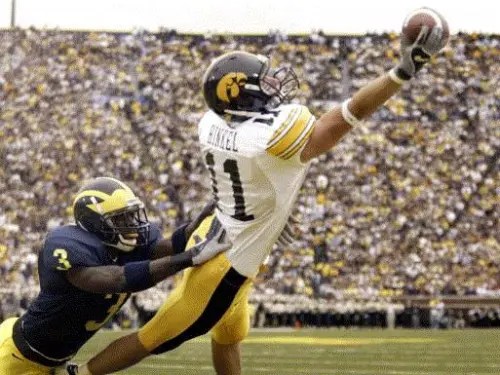
Iowa’s Drew Tate was the signal caller for the country’s 70th ranked scoring offense. Coming into the Capital One Bowl, the Hawkeyes were averaging less than 75 yards rushing per game. This may come as a shock to those present day Iowa football-enjoyers, but they were a much better throwing team in 2004. Tate and the Hawkeyes ranked third in the Big Ten and top 25 nationally in passing yards per game. Clinton Solomon and Ed Hinkel were the leading receivers headed into the bowl game, with 824 and 651 yards, respectively. This duo combined for 12 of Tate’s 18 passing touchdowns thus far on the year.
The strongest unit on the team was undoubtedly the defense. The Hawkeyes were 17th in scoring defense, 11th in total defense, 5th in rushing defense, and 3rd in turnovers. The front seven included All-Big Ten selections Jonathan Babineaux and Matt Roth, and linebackers Abdul Hodge and Chad Greenway. The Black and Gold defense led by defensive coordinator Norm Parker was nasty.
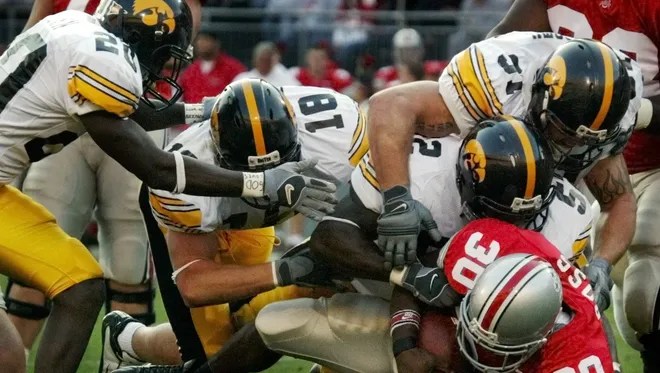
First Half
To no one’s surprise, Iowa struck first with a big play through the air. LSU brought a seven-man pressure on 3rd-and-8, blitzing the slot corner and a safety. Tate made them pay, as he hit a well-covered Solomon on a slant route right at midfield. Solomon beat Tigers’ CB Webster with an inside move, and with no safety help over the top, the LSU defense was cooked. Solomon took it to the house from 57-yards out to put Iowa up 7-0 on the game’s first possession.
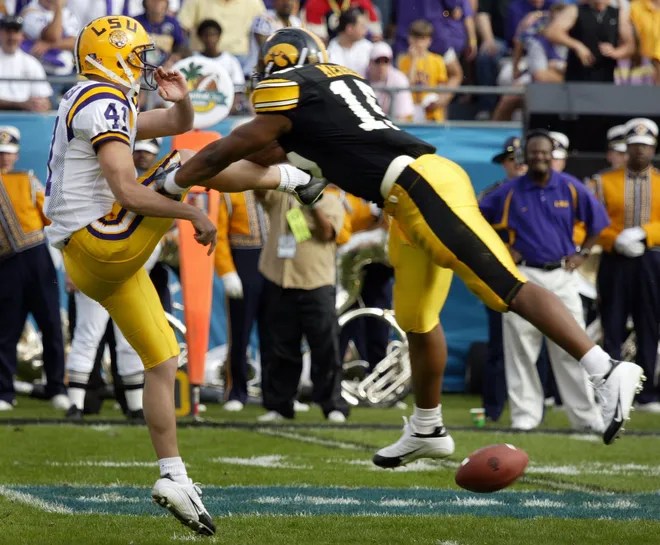
After first-down tosses to Green and Bowe, Marcus Randall and the LSU offense stalled and were forced to punt on their first possession. The Tigers then forced an Iowa three-and-out and punt, and took over at their own 24-yard line. LSU couldn’t get anything going and lined up in punt formation on 4th-and-7. The Hawkeyes’ special teams unit stepped up, blocking Chris Jackson’s punt and taking over inside the Tigers’ 30-yard line.
On the very next play, Iowa would give the ball back to the Tigers, as Tate’s screen pass was intercepted by LSU defensive tackle Melvin Oliver. After a 27-yard return by the big man, LSU looked prime to take advantage of the short field. On their first play of the drive, a hand-off attempt from Randall to Broussard was broken up by Babineaux, who blew by a pulling Whitworth. The Tigers recovered but lost 11-yards on the play. After a near-interception and a one-yard run by Randall, LSU punted the ball away.
Iowa’s next drive was a short one. After Tate was forced to step up in the pocket on third-and-long, he made an ill-advised jump pass across the middle directly into the arms of Landry. LSU took over at the Hawkeyes’ 31-yard line. Once again, the Iowa defense stepped up. LSU gained one first down but were forced to settle for a field goal. Less than 10 seconds into the second quarter, the score was 7-3 Hawkeyes.
LSU sacked Tate twice on the next drive, forcing a 4th-and-29 David Bradley punt from deep inside the Hawkeyes’ own territory. LSU picked up a key third-down conversion on a pass from Randall to Bowe on their next drive. After Randall missed Davis on a deep shot near the pylon, Jackson came in to kick a 47-yard field goal through the uprights. With nine and a half minutes left in the first half, the Hawkeyes still led 7-6.
The next eight minutes saw each team get two possessions; neither offense was able to do anything with the ball. With 72 seconds remaining in the half, LSU lined up in punt formation after another three-and-out. Hawkeyes’ defensive back Miguel Merrick ran untouched by LSU’s Marcus Spears to block the Jackson punt. This time, Iowa was able to capitalize on a big special teams play, as DB Sean Considine picked up the bouncing ball and took it in the end zone for a touchdown.
The end of the first half provided even more fireworks. On the ensuing LSU drive, Broussard took the hand-off from newly inserted QB Matt Flynn and ran 74-yards for a score. On a two-point conversion attempt, Dwayne Bowe’s catch was nullified by an offensive pass interference call. LSU was called for a procedural penalty on the next play, turning it into a 40-yard extra point attempt with the wind whipping. The kick sailed way left and the score stayed at 14-12 in favor of Iowa.
Second Half
The Tigers began the third quarter with the ball. Several tough, short-yardage runs by Addai and passes to Green and Bowe got LSU down near the 50-yard line. Randall’s pass on first-down intended for Davis was well short and was intercepted by Iowa DB Jovon Johnson. On the Hawkeyes’ next drive, Tate found WR Ed Hinkel four times for 58 yards on this drive. The Hawkeyes struggled after getting the ball inside the LSU 5-yard line, and settled for a field goal. They led 17-12 with 10:04 remaining in the third quarter.
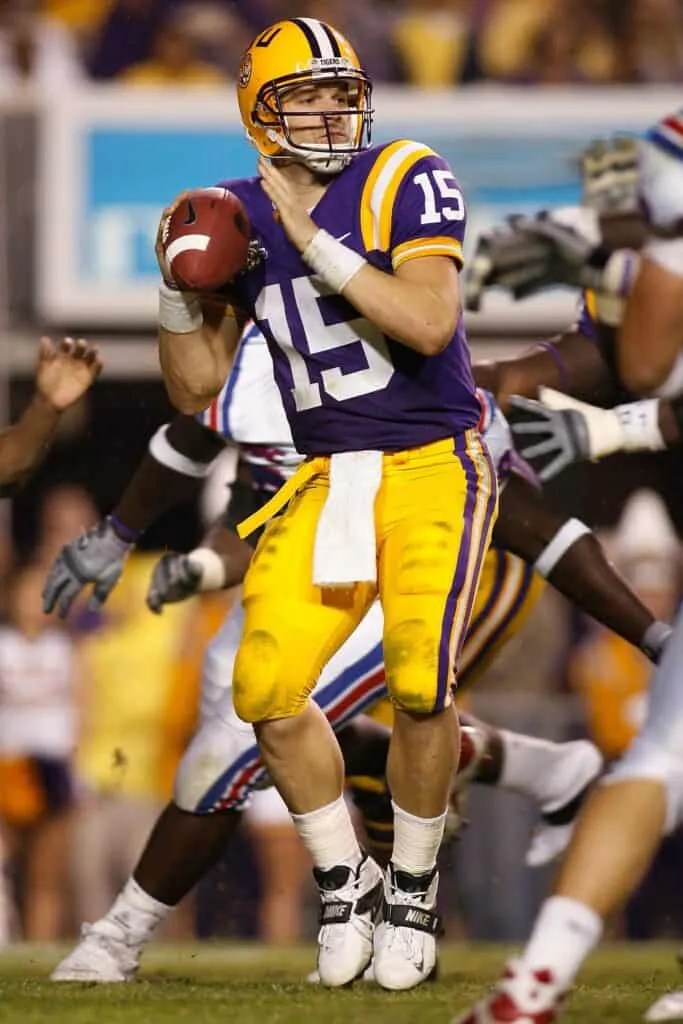
Tigers’ return man Skyler Green took the ensuing kickoff all the way back across midfield into Iowa territory. Aided by a facemask penalty during the kick, LSU started their possession at the Hawkeyes’ 26-yard line. After suffering bruised ribs, Randall was replaced by Flynn, and the redshirt-freshman was rewarded by going three-and-out on his first drive. LSU attempted a fake field goal, with Flynn taking the snap and running up the middle and coming up short. The Tigers offense had once again wasted incredible field position and come up with zero points.
After Iowa picked up a couple of first downs on their next drive, pressure from the LSU defensive line and penalties killed any hopes of a Hawks score. Same story, different uniform for the Bayou Bengals on their next drive. After a Bowe first down catch and a couple of Broussard runs, the Tigers punted the ball back to Iowa.
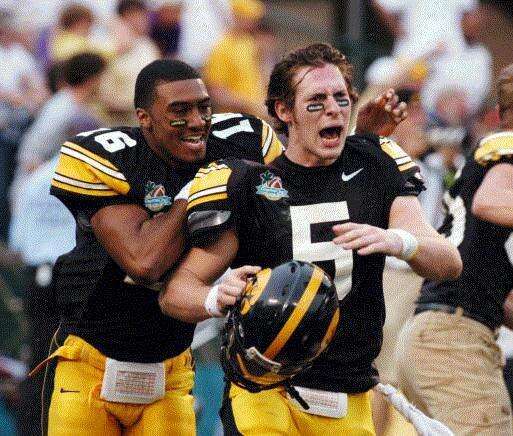
After three straight runs and a first down, Tate found his tight end Scott Chandler for a gain of 20. Several plays later, he tossed another pass to Chandler this time on a well-executed tight end screen play. Chandler gained another 20-yards on this catch, taking the ball down inside the 5-yard line. One play later, running back Marques Simmons took the hand-off to the left for a score. Hawks went up 24-12 with less than 13 minutes left in the ball game.
JaMarcus Russell replaced Flynn on the next LSU drive. The 6-foot-5, 250-pound redshirt-freshman QB completed passes to Davis, Bowe, and Broussard before connecting for a 22-yard touchdown pass to Skyler Green. With 8:21 left in the fourth quarter, Russell had reinvigorated the LSU offense and cut the Hawkeyes’ lead to 24-19.
On Iowa’s next drive, Tate connected with Solomon on a third-and-seven pickup after a poor throw went through an LSU defender’s arms. A few unsuccessful runs and a false start penalty killed the drive, and Iowa was forced to punt with five and a half minutes left in the game. A good Bradley punt flipped the field and LSU stared the next drive at their own 31.
Russell came out strong, hitting Green on consecutive passes to start the drive. After a short Broussard run, Russell hit Addai on the check-down for a gain of about seven. On third-and-three, Doucet picked up all but a half-yard on a pass from Russell. With 2:16 left, LSU picked up a huge 4th-and-1 with Broussard gaining eight yards. Bowe made a sliding grab near the sideline on first down to get the Tigers down inside the 15-yard line. Addai caught another pass for a first down on an angle route from Russell. LSU now had the ball first-and-goal from the 3.
After an inexplicable spike on first down with 50 seconds left, Russell hit Green in stride near the back of the end zone for a touchdown. The Tigers took the lead for the first time all day, and after missing the two-point try, led 25-24 with 46 seconds left in regulation. The Tigers had already completed four fourth-quarter comebacks in the 2004 season, and they were looking to make the Hawkeyes victim #5.
Iowa returned the kickoff to the 30-yard line, and Tate was given 39 seconds and two timeouts to go try and win the game for the Hawkeyes. Hinkel made an 11-yard catch past the 40-yard line on first down. The next play was a pass to WR Warren Holloway for a gain of nine-yards, short of the first down. The clock continued to run. Instead of calling a timeout, Tate spiked the ball. Due to the rush to the line, the offense wasn’t completely set and a false start was called. The Hawkeyes were backed up to their own 44-yard line. Still no timeout called. As Tate takes the snap, seconds continue to tick off.
Tate takes the snap with three receivers lined up to his right, and one to his left. He takes a three-step drop, then takes a step back up into the pocket and launches the ball down field to a wide open Holloway. Holloway catches the frozen rope of a pass in stride near the 15-yard line and races into the end zone. Iowa wins an absolute thriller 30-25 in the most Iowa-way possible: an explosive 56-yard pass play for a touchdown as time expires.
Post-Game
JaMarcus Russell led the offensive resurgence for LSU and gave the Tigers the opportunity to come away with the win. Russell finished 12 of 15 for 128 and 2 touchdowns despite not coming into the game until the fourth quarter was already under way. Running back Alley Broussard rushed for 109 yards, although 74 of those yards came on one play. Dwayne Bowe led all LSU pass catchers with 8 catches and 122 yards.
Drew Tate threw for 287 yards and 2 touchdowns and earned the game’s MVP award. The Iowa rushing attack was pretty much non-existent, as expected. The Hawkeyes defense and special teams showed up and showed out. The blocked punt for a touchdown was crucial, but so was the punting of David Bradley. He averaged nearly 50-yards per punt, flipping the field position in favor of the Hawkeyes multiple times.
Aftermath
As you may already know, Nick Saban never coached LSU again. He left for the Miami Dolphins for two seasons before returning to college football in 2007. LSU won a national championship that season, with a small group of players from the 2004 season still on the team. Saban went to coach in Tuscaloosa, Alabama. He did a decent job there with the Crimson Tide. LSU just made major headlines by hiring Lane Kiffin, a future Saban assistant coach. The Tigers will play in the Texas Bowl against Houston at 8:15 PM CT on December 27th, 2025.
Kirk Ferentz is in his 27th season at Iowa and is currently the longest-tenured coach in college football. The Hawkeyes are still an exciting team on defense and special teams, but a lot has changed offensively since the Drew Tate days. Iowa has more of a ground-and-pound rushing style; scoring 30 points in a single game seems a little excessive. Iowa has most of America rooting for them–as it should always be–when they square off against a Vanderbilt Commodores team in the ReliaQuest Bowl on New Year’s Eve in Tampa.


Leave a comment