

Rivalries in college football don’t really need additional stakes. There are rarely national championship implications surrounding the Egg Bowl, the Holy War, or Farmageddon. But that should not (and does not) take away the significance of those games. The old cliches of “you can throw out the records for this matchup” or “I don’t care if we go 1-11 as long as we beat Rival State U” exist for a reason; they’re true. However, on Nov. 24th, 2007, the records mattered, the rankings mattered, and the rivalry between Kansas and Missouri was reinvigorated.
With Les Miles and LSU already having lost to Arkansas in triple overtime on Black Friday, the winner of the Border War was likely to move up into the No. 1 spot in the AP Poll. Speaking of those Bayou Bengals, the 3OT defeat was their second such instance of the season. In mid-October, as the top-ranked team in the country, LSU lost to Kentucky 43-37 in Lexington.
Heading into the game, Kansas was No. 2 in both the AP Poll and the BCS rankings, Missouri was third in the AP and fourth in the BCS. West Virginia and Ohio State were one-loss teams near the top of the polls with the Jayhawks and Tigers. The top spot was there for the taking, and the raucous Arrowhead Stadium crowd was geared up to witness the most important game in the 116-year-old rivalry’s history.
Border War History
The football rivalry between the two schools is one of the oldest in the country. The last game between the Tigers and Jayhawks was in 2011, as Missouri left the Big 12 for the SEC the following season. At that time, it was the second most played game in the FBS with 120 meetings, behind only Minnesota versus Wisconsin. The first of those was Halloween 1891, a 22-10 KU win. The series record is 57-54-9 in favor of Missouri. The Tigers won just four of the first 22 meetings between the schools, but from 1913 to 1970, Missouri went 33-19-5 against the Jayhawks.
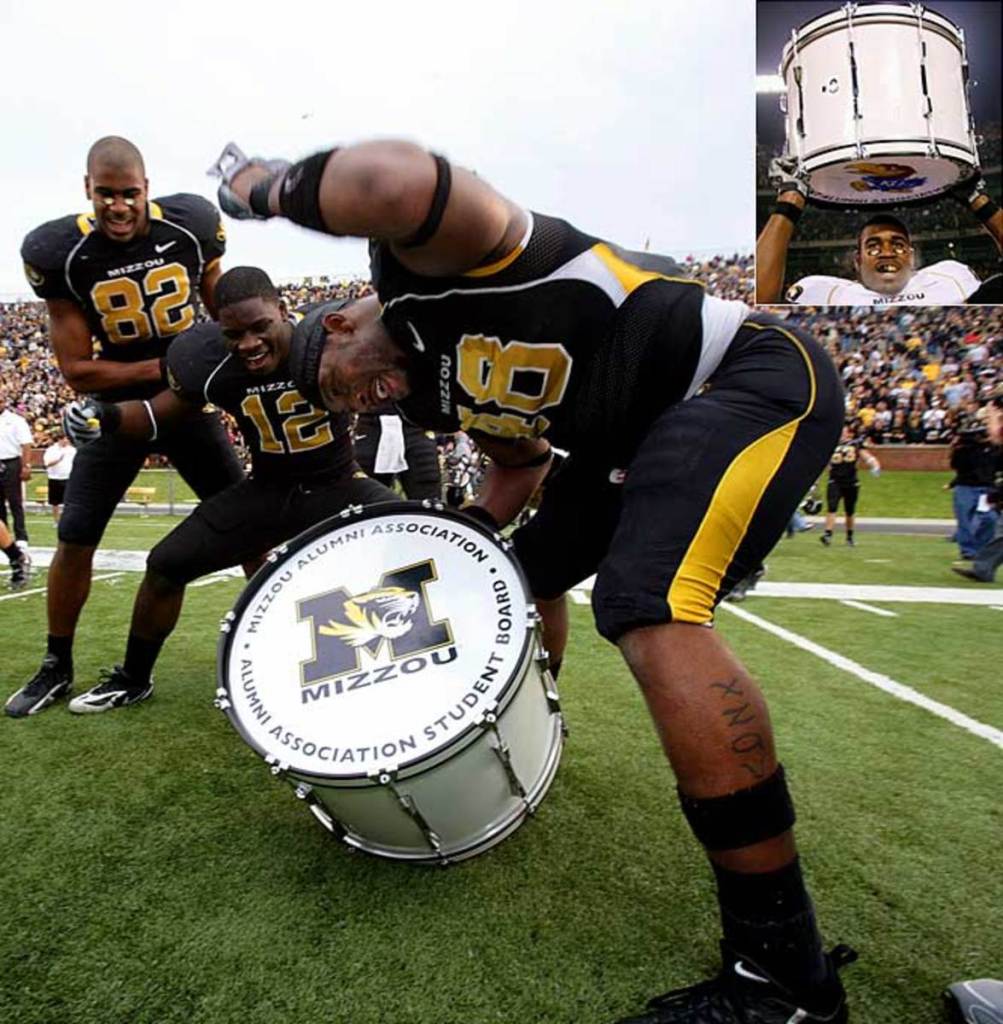
1960
The most controversial match-up in the series took place in 1960, although the game itself was relatively free from any shenanigans. On the field, the Jayhawks won 23-7 over the undefeated, No. 1 ranked Tigers. Kansas came into the contest at 6-2, ranked No. 11 in the country. The two losses came at Syracuse and Iowa, who were both ranked No. 1 in the country at the time the Jayhawks played them. Kansas made history by playing three No. 1 ranked teams in the same season. With the victory, KU won the Big 8 title and earned an Orange Bowl bid.
The controversy surrounded the eligibility of Bert Coan, the Jayhawks 6-5, 220-lb. halfback. In the game, Coan ran the ball 9 times for 67 yards and scored 2 touchdowns. But on December 8th, 1960, he was determined to be ineligible due to an off campus recruiting violation. Coan had transferred in from TCU in the fall of 1959. The summer before the season started, he had taken an ‘illegal off campus recruiting visit’ to a football all-star game and his plane ticket was paid for by Kansas donor Bud Adams. The Big 8 Conference officials forfeited the game to Missouri, along with the Big 8 championship and the Orange Bowl invite.
From 1971 to 2006, the Jayhawks took control of the rivalry, going 21-15 against the Tigers. Heading into the 2007 game, Mark Mangino had a 3-2 advantage over Mizzou during his tenure. Kansas had already set a school record for wins in a season and were looking for the first undefeated and untied regular season since 1908, when they were a member of the Missouri Valley Conference.
1st Quarter
The chilly, 35-degree conditions did nothing to calm the palpable electricity in Arrowhead. Missouri received the opening kickoff, which freshman WR Jeremy Maclin took to near the 40-yard line. If not for running into his own blocker, Maclin may have had a chance to take this kick all the way to the house. For the first 6 minutes of the ball game, the defenses were on display. Each team went three-and-out on their first two drives.
A 43-yard punt return by Maclin followed by a first-down pass from QB Chase Daniel to WR Tommy Saunders had the Tigers in business inside the Jayhawks’ 20-yard line. But a costly personal foul call on WR Will Franklin stalled the drive and Mizzou settled for a field goal attempt. The Tigers ran a fake but were unsuccessful in converting the 4th-and-12 and Kansas took over on downs.
The Jayhawks’ offense finally picked up a first down but could not keep the drive going after QB Todd Reesing narrowly missed connecting with WR Dexton Fields for an explosive pass play. After the KU punt, Missouri went 78 yards on 11 plays in three and a half minutes, aided by big gains on the ground from RB Tony Temple. The Tigers capped off the drive with a Daniel to Martin Rucker 1-yard TD pass on a TE screen for the game’s first points.
2nd Quarter
At the start of the second quarter, Kansas finally showed signs of life on offense, as Reesing hit former quarterback-turned-receiver Kerry Meier for a 40-yard completion. The exhilaration was short-lived, as Reesing’s next pass landed in the hands of Missouri’s All-American defensive back William Moore at the 2-yard line.
The Tigers moved the ball down the field quickly after big runs by Temple and RB Jimmy Jackson. Danario Alexander made three big catches on the drive, including an 11-yard TD reception on third down. The Tigers were up 14-0 with just over 9 minutes left in the second quarter.
Kansas had their most consistent drive of the game, picking up three first downs to get inside the Missouri 20-yard line. Reliable kicker Scott Webb doinked a chip-shot off the right upright and the Tigers took back possession of the ball. Mizzou picked up several first downs through the air with big catches from Rucker and Saunders. The KU defense stiffened and turned the ball over on downs after stopping the Tigers on a 4th-and-1.
Reesing immediately went deep to Fields for a big 30-yard completion and gained 15 more yards after a roughing the passer penalty. But a pass deflection, incompletion, and a sack put the KU offense in reverse and forced the Jayhawks to attempt another field goal. Webb’s 45-yarder hooked left, and KU squandered another scoring opportunity with just under two minutes remaining in the half. Missouri would pick up a couple of first downs before punting with seconds left in the half. The Jayhawks took a knee and headed to the locker room to regroup after a head-scratching first-half performance on offense.
3rd Quarter
After another promising drive to begin the third quarter, the Jayhawks once again shot themselves in the foot. Reesing’s third-down pass was behind WR Marcus Henry, who deflected it into the waiting arms of Missouri CB Castine Bridges, who returned the ball 49 yards to the Kansas 40-yard line. Two minutes and seven plays later, Jackson punched it in from one yard out to make it 21-0 Tigers.
On Kansas’ next possession, Reesing and company finally got it done. WR Dezmon Briscoe was the favorite target, first with a 12-yard catch and run and an incredible diving catch for 34 yards several plays later to set up KU inside the 5-yard line. Three plays later, RB Brandon McAnderson punched it in from the 1-yard line to cut the lead to 21-7.
Missouri went on a 13-play drive, covering 69 yards in just over 6 minutes, punctuated by a three-yard TD pass from Daniel to RB Derrick Washington. Kansas had no answers for the Tigers offense, particularly with Temple who had already rushed for over 100 yards. Alexander continued to punish the KU defense as well, making several more catches to go over the century mark in receiving yards.
4th Quarter
Down 28-7 with 1:15 left in the third quarter, Reesing led the Jayhawks on their second scoring drive of the night. Reesing hit Fields for 23 yards on the second play of the drive. After a 7-yard scramble to set up 4th-and-3, Reesing went to his favorite target Henry for a gain of 12 to keep the drive going. After two costly penalties by Tigers safety William Moore and a 9-yard completion to Briscoe, the Jayhwaks had the ball inside the 5-yard line. Several plays later, Reesing converts a 4th down into a touchdown on a play action rollout cutting Missouri’s lead to 28-14 with 13 minutes left.
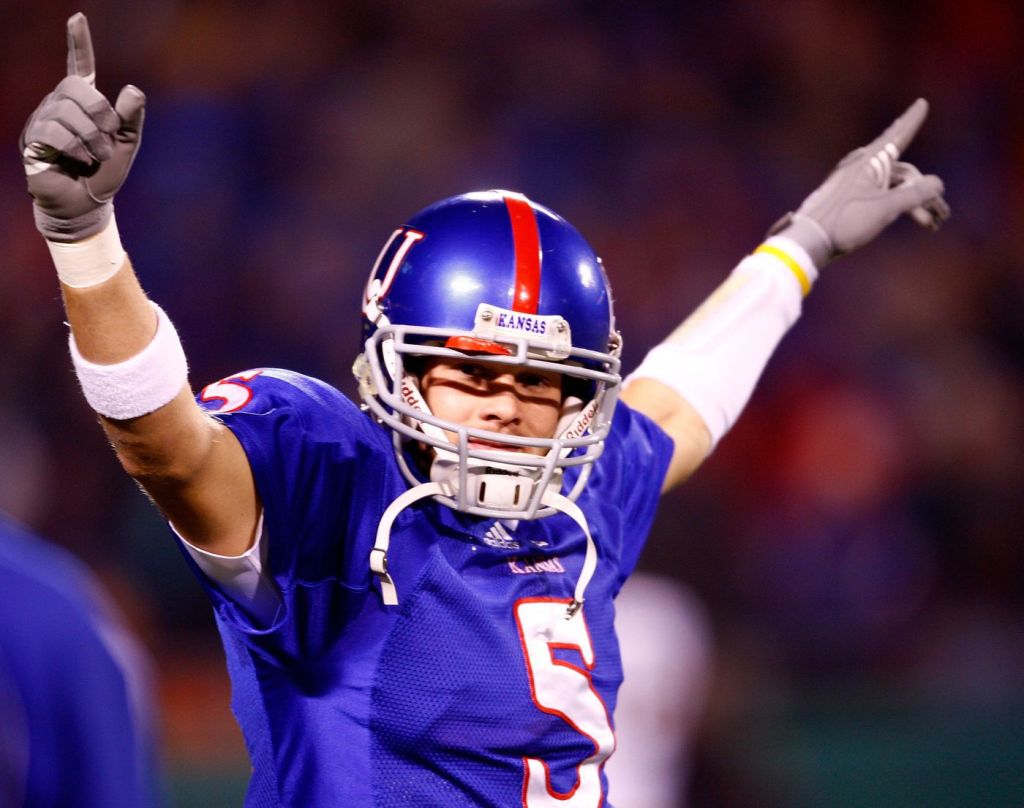
Daniel led Mizzou on a 10-play, 44-yard field goal drive lasting a little over 3 minutes to extend the lead to 31-14. Daniel found Maclin twice and hit the tight end Rucker for a big gain. After Kansas took the ensuing kickoff out to the 43-yard line, Reesing and the offense went to work. He hit Briscoe on back-to-back throws to pick up a first down, then connected with Meier for 19 yards to get inside the 20-yard line. After another connection with Briscoe for 8 yards, Reesing finds Fields on a corner route in the end zone to trim the Tiger lead to ten with 8 and half to go.
On the ensuing Mizzou possession, big plays by Maclin and Alexander helped extend the drive for the Tigers. Daniel and the offense were able to bleed 5 minutes off the clock and add a field goal to make it 34-21 with three and a half minutes remaining.
Reesing showed his toughness on the next drive, scrambling to convert a 4th-and-3 inside the Mizzou 30. Completions by Meier and McAnderson set KU up inside the 5, where Reesing found Marcus Henry for 6. With 2:03 left in the game, the Jayhawks were within a touchdown of winning the Border War. The offense found the endzone for the fourth consecutive drive.
Missouri got the ball back after a failed onside kick attempt by Kansas, prompting three consecutive runs up the middle to bleed the clock. After the punt, Kansas received the ball at their own 11-yard line with 17 seconds to go. On the first (and only) play of the Jayhawks drive, the Tigers sacked Reesing in the endzone for a safety using just a four-man rush. The final score was 36-28.
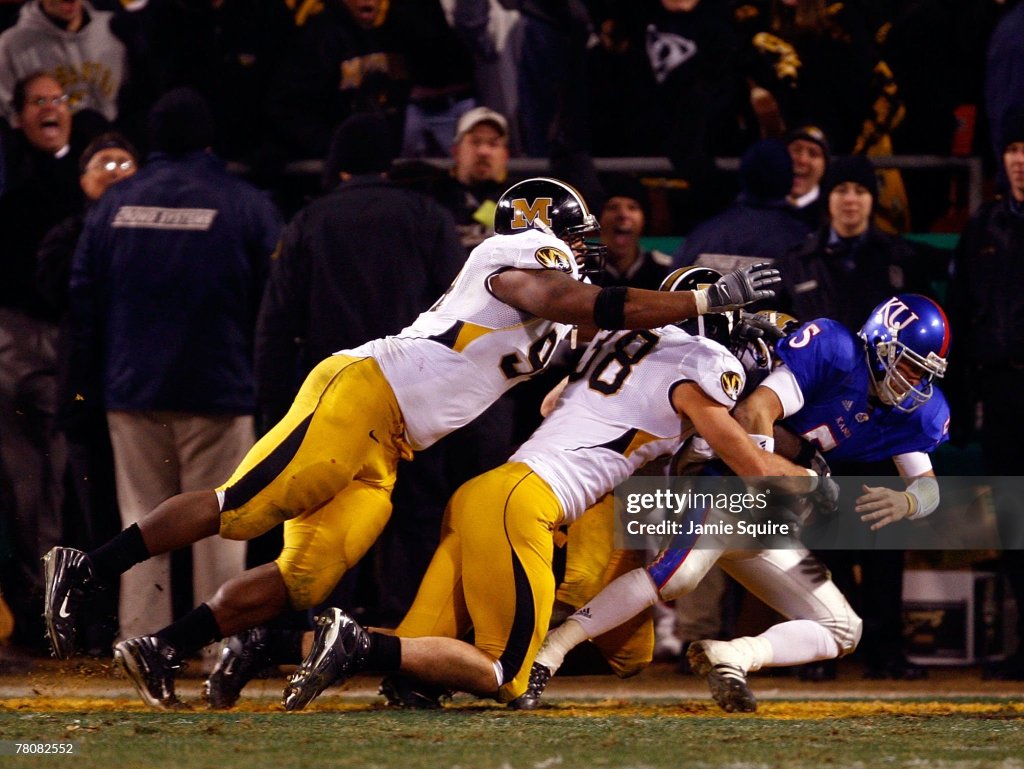
Missouri would claim the Big 12 North title and get a rematch against Oklahoma in the Big 12 Championship Game. More importantly, they beat their rival and owned bragging rights in the Border War for at least another year.
Post-Mortem
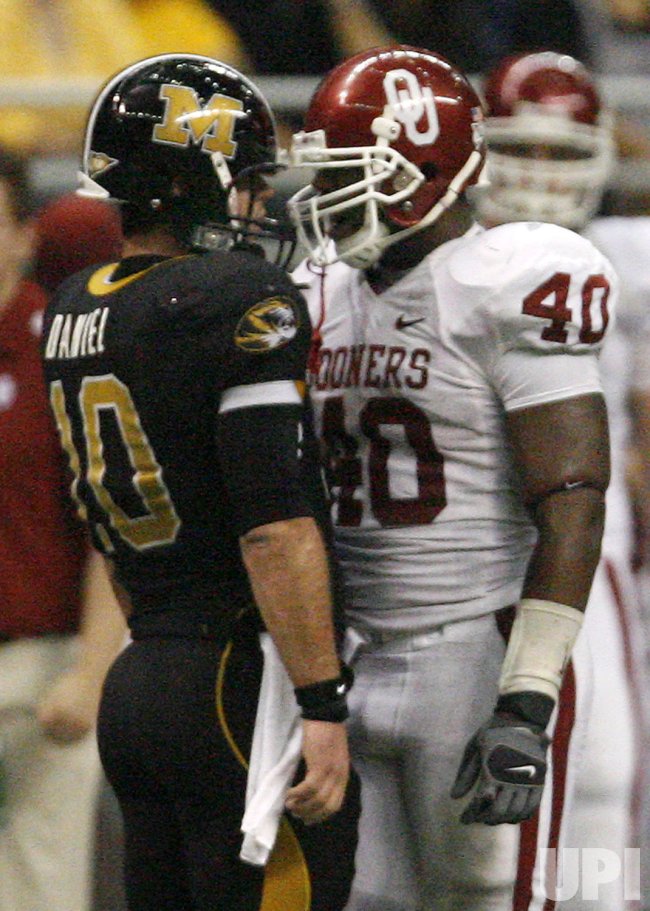
Missouri climbed to No. 1 in the country after this win; for one week. The Tigers lost the Big 12 title to the Oklahoma Sooners 38-17 in San Antonio, Texas. Missouri’s run game was virtually non-existent, averaging barely 3 yards per carry. Sooners QB Sam Bradford outdueled Daniel, who finished with 219 passing yards and an interception. The Tigers would thrash Arkansas in the Cotton Bowl 38-7 on New Year’s Day 2008. Missouri finished the year ranked No. 4 in the AP Poll at 12-2 with both losses being to Oklahoma.
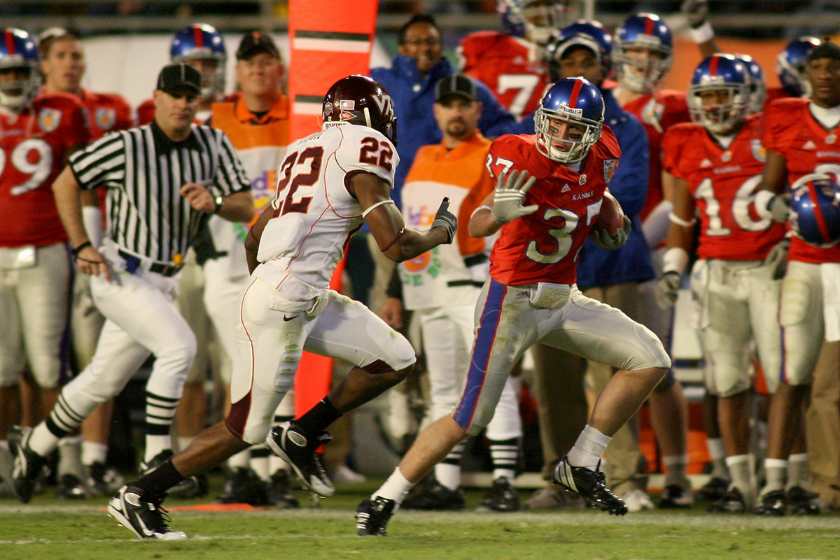
Kansas played in the Orange Bowl against the ACC Champion, the Virginia Tech Hokies. The game was a classic that including a Hokie punt return touchdown (big surprise there) and an Aqib Talib pick six. The Jayhawks came out on top in Miami, 24-21. Coach Mangino’s squad placed 7th in the AP after their 12-1 finish to 2007.
The Border War rivals each missed out on their opportunity to play for a BCS title. Instead, those honors went to Ohio State and LSU, two of college football’s bluest blue bloods. As Kirk Herbstreit predicted, West Virginia messed around and lost in the Backyard Brawl to a dreadful Pitt team.
At the time, the Georgia Bulldogs appeared to be one of the hottest teams in the country. However, the voters (and the BCS computers) could not overlook an early season home loss to a South Carolina team that dropped its’ final five games of the year. Coupled with a blowout loss to the SEC East champion Tennessee, the Dawgs found themselves headed to the Sugar Bowl to face Colt Brennan and Hawaii.
Florida freshman QB Tim Tebow won the Heisman Trophy, but Chase Daniel represented Mizzou well in New York City. The Jayhawks’ Mangino collected a heap of well-deserved Coach of the Year awards for his phenomenal work in Lawrence.
Unbeknownst to anyone, this was not only the high mark of the Border War rivalry, but it was also the beginning of the end. Missouri bolted for the SEC after the 2011 season and has not played the Jayhawks since. The two are scheduled for home-and-homes in 2025-26 and 2031-32.
 College Football Stories
Leave a comment