
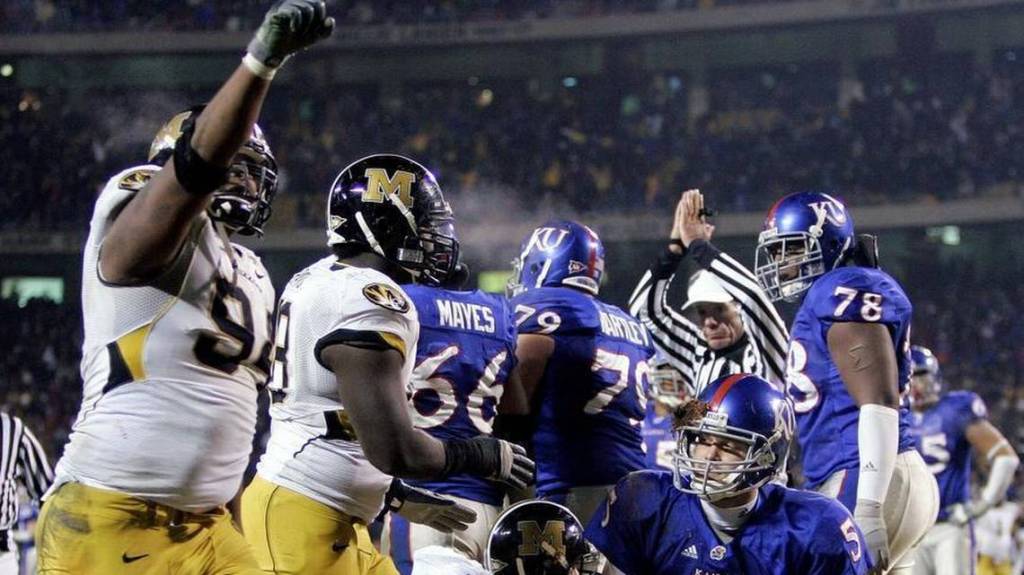
It has been well documented that the 2007 college football season was certifiably insane. Nothing illustrates that fact more than the top 5 match-up between Kansas and Missouri to end the regular season. The setting was Arrowhead Stadium in Kansas City. College Gameday was on location. Brent Musburger and Kirk Herbstreit were in the broadcasting booth for ESPN. Conference and national championship hopes were on the line for both teams. And more than that, this was rivalry week between conference foes that despised each other’s sheer existence. In a season full of improbable storybook endings, this was the magnum opus.

This is the first installation of a three-piece series. The initial story will primarily focus on the 2007 Missouri Tigers, including the important moments leading up to their rivalry matchup with Kansas at the end of the regular season. Part two will offer the Jayhawk perspective of that wild, historic year. The third and final entry will focus on the game of the year in college football in 2007: the November 24th Border War between No. 2 Kansas and No. 4 Missouri. Included in the final post will be the aftermath of that game for each team as well as the rest of the college football world. Sit back and enjoy!
Pre-season Expectations
Of the two teams, Missouri had higher expectations heading into the 2007 season. The Tigers were a solid team in 2006, finishing 8-5 overall, with a 4-4 mark in Big 12 play. Missouri started out scorching hot at 7-1, reaching No. 19 in the AP poll. They lost four of their final five games, including a Sun Bowl loss to Oregon State. Their one win during that stretch was a 42-17 drubbing of Kansas at home in Columbia.
They returned starting quarterback Chase Daniel, who put up respectable numbers in 2006: over 3,500 passing yards and a 28-10 touchdown to interception ratio. The Tigers were top 20 in scoring offense and ranked 33rd in scoring defense.
Missouri was the sportswriters’ pick to win the Big 12 North division, just ahead of Nebraska. For context, the Big 12’s South division held Texas, Oklahoma, and Texas A&M at the time. These three teams, along with Nebraska, were the only Big 12 teams ranked in the pre-season AP Top 25.
Prior to 2007, Missouri had never made it to the Big 12 Conference Championship Game. In fact, their last conference championship was in 1969 as a member of the Big 8 Conference. Lindy’s pre-season preview magazine had the Tigers rated as the No. 28 team in the country entering the year.
M-I-Z
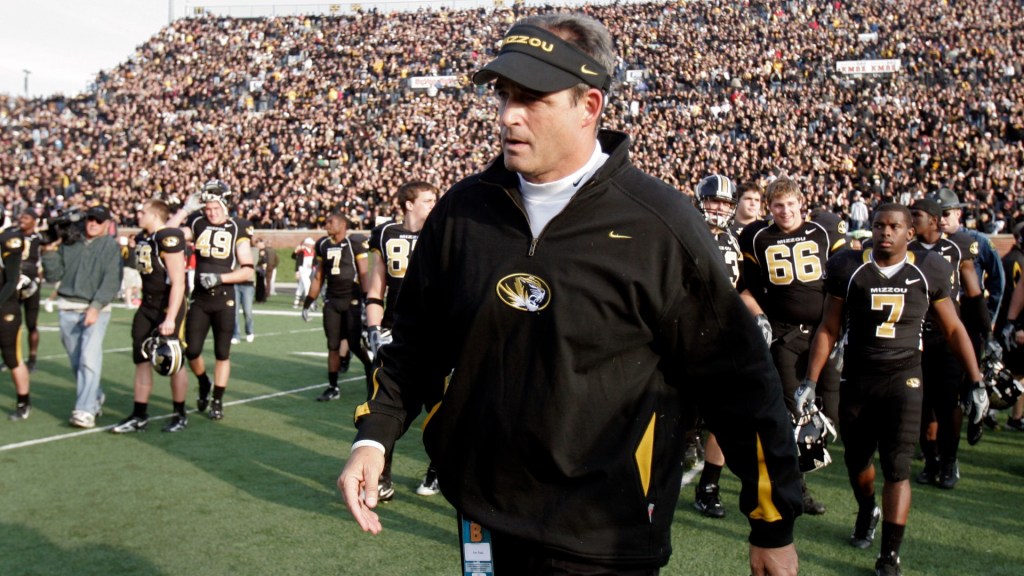
Prior to head coach Gary Pinkel’s arrival in 2001, Missouri football was middling at best; more often than not, they were the conference bottom-feeders. From 1984-1996, the Tigers had 11 seasons with seven or more losses and failed to make a single bowl game. Pinkel had his struggles in the first two years of his tenure in Columbia, going 9-16 from 2001-2002. The Tigers broke through in 2003, going 8-5 with an Independence Bowl appearance. Over the next three seasons, Missouri went 20-16, with a 1-1 record in bowl games, but never better than .500 in conference play. 2007 was the year that they turned that around.
Offense
The Tigers took a massive leap forward in 2007 primarily due to their improvements on offense. They finished the year ranked 8th in points per game, averaging 39.9. Daniel finished 4th in the Heisman Trophy voting after throwing for over 4,300 yards and 33 TDs. He also rushed for 253 rushing yards and 4 scores. Senior running back Tony Temple rushed for over 1,000 yards and averaged 5.6 yards per carry. The Tigers’ receiving corps was anchored by freshman Jeremy Maclin, who caught 80 passes for 1,055 yards and 9 TDs. Maclin also rushed for 375 yards and 4 rushing TDs, averaging 7.4 YPC. Senior wide receiver William Franklin added 49 receptions for 709 yards and 4 scores. Tight ends Martin Rucker and Chase Coffman, each of whom were future NFL Draft picks, accounted for 136 catches, 1,365 yards, and 15 TDs in total.
Defense
Defensive coordinator Matt Eberflus’ unit allowed just over 23 PPG, good for 38th out of 119 FBS teams. The defense was led by linebacker Sean Weatherspoon and second-team AP All-American safety William Moore. Weatherspoon had 127 total tackles and 10 TFL, while Moore led the nation with 8 INTs.
The Tigers were emblematic of many Big 12 defenses in this early era of the Spread and Air Raid offensive attacks: stout against the run but susceptible through the air. The Tigers defense allowed just 3.6 yards per rush. They were ranked 97th against the pass, giving up an average of over 256 yards per game. That was good for 8th in the Big 12, a league who only had one team (Texas Tech) ranked higher than 47th defending the pass. Ironically, the Red Raiders also led the country in passing yards per game on offense, averaging more than 470 each game.
Setting the Table
The Tigers opened the year with a neutral site match-up in St. Louis against Illinois. Daniel threw for over 350 yards and 3 TDs en route to a 40-34 victory over the Fighting Illini. Ron Zook’s Illini finished the 2007 season 9-4 and appeared in the Rose Bowl. The highlight of their season was an upset win on the road in the Horseshoe against eventual national runner-up Ohio State.
Missouri traveled to Oxford, Miss., a week later to face off with the Ed Orgeron-led Ole Miss Rebels. The Tigers built a 35-7 lead after a 28-point second quarter explosion. Missouri leaned heavily on the legs of Temple, who rushed for 123 yards on 17 carries. The Rebels made a push late in the game to make it interesting, but Missouri held on to win in the Grove 38-25.
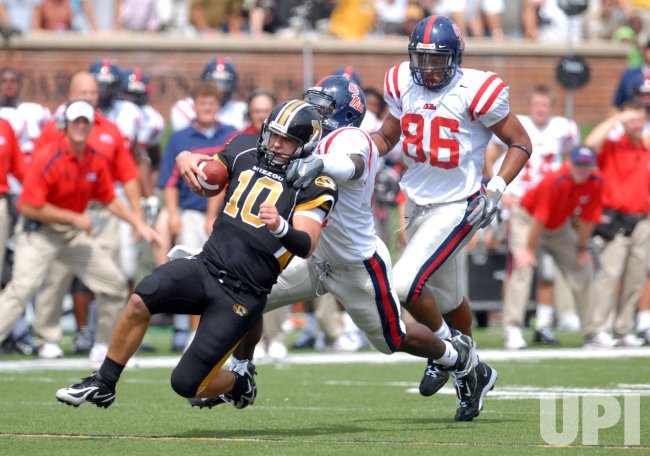
The next two weeks were light for the Tigers. They took care of business against MAC school Western Michigan 52-24 and handled FCS opponent Illinois State 38-17. The offense was humming as Temple averaged over 100 yards rushing and 2 TDs in each game. Freshman sensation Maclin had 513 all-purpose yards and 4 TDs over the two-game span. Next up was a crucial bye week to prepare for their Big 12 opener against hated rival Nebraska.
Big Red Redemption
Historically, the Cornhuskers owned Missouri. The two schools had split the last four meetings from 2003 to 2006, but from 1979 to 2002, Nebraska won every contest. Many of those 24 straight losses were blowouts. The worst stretch was from 1993 to 1996, where Nebraska won by an average of over 44 points. Needless to say, Missouri was more than ready to exorcise some Big Red demons if given the opportunity. And on October 6th, 2007, in Columbia, Mo., the Tigers unleashed years of pent-up frustration with a 41-6 beat down of Bill Callahan and his Huskers.
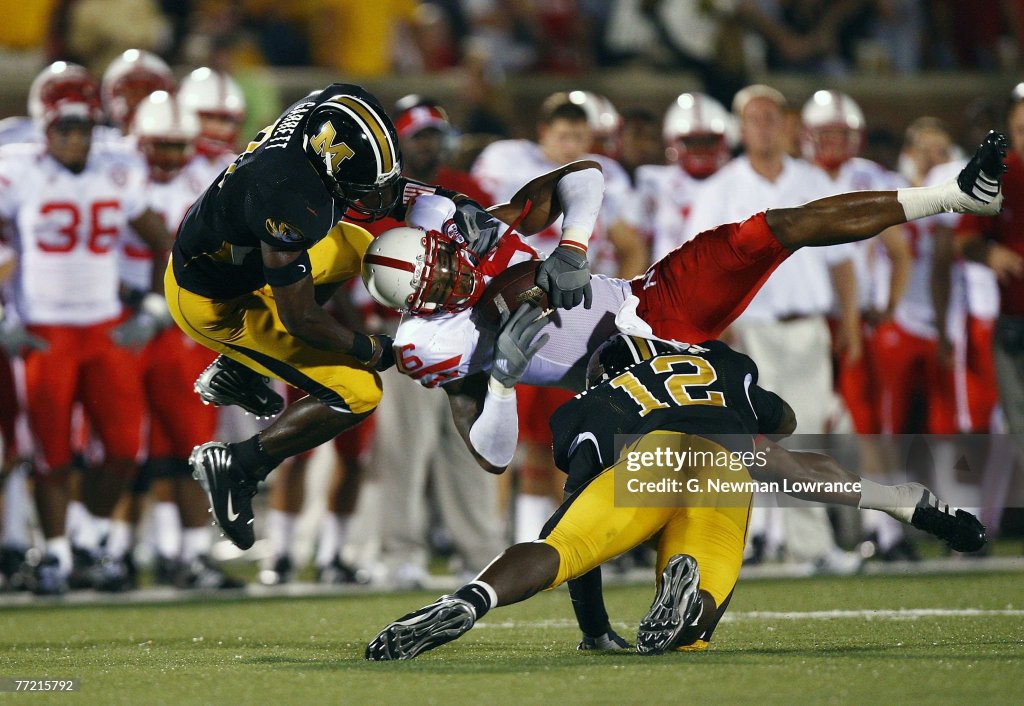
Daniel threw for 401 yards, rushed for 72 more, and accounted for 4 total TDs. Maclin had over 120 all-purpose yards and tight end Martin Rucker had over 100 receiving yards to go along with a TD reception. The offense put up over 600 yards of total offense, but the story of this game was the suffocating Tigers defense. Missouri held Nebraska to under 300 total yards, including just 5.4 yards per pass attempt, and 3 yards per rush. The Cornhuskers were just 6 of 17 on third and fourth downs. Missouri recorded 4 tackles for loss and an interception while forcing five punts and two short field goal attempts.
Mizzou was on top of the world after the Cornhusker thumping, but that euphoric feeling would be short lived. The Tigers other longtime nemesis awaited in Norman, Oklahoma. Prior to the end of World War II, the record between the Oklahoma Sooners and Missouri Tigers was 16-16-4, including the thrilling 0-0 finish in 1930; who could forget that?
After the troops came home from the European and Pacific fronts, the rivalry for the “Tiger-Sooner Peace Pipe” (yes, look it up) got a little more one-sided. The Sooners won 14 in a row from 1946-1959. From 1960-2006, Oklahoma owned the series 33-7-1. The Tigers hadn’t won in Norman since 1966.
TrOUble in Norman
College Gameday was on site in Norman for this matchup between two teams ranked in the top 11 of the AP Poll. Missouri struck first against the 6th-ranked Sooners early in the first quarter after Maclin took a reverse 5 yards to the corner of the endzone. On the ensuing possession, OU QB Sam Bradford marched the Sooners down the field and hit WR Juaquin Iglesias on a slant for a 4-yard TD to tie the game. The Tigers next drive involved a sack on first down, a substitution penalty on third down, followed up by a Chase Daniel interception returned inside the red zone.
The Sooners finished off that drive with a field goal to take the lead 10-7. Missouri’s next two drives netted only 25 total yards on 12 plays, ending with two punts. OU stretched their lead to 17-7 with under two minutes left in the first half. The Tigers marched downfield after two big plays from Maclin: a 14-yard rush and 31-yard catch. Missouri kicked a field goal to bring the score to 17-10 at the break.
The Sooners picked off Daniel again on Mizzou’s first drive of the second half, then quickly scored to extend their lead to 13. The Tigers fought back and took a 24-23 lead heading to the fourth quarter. Missouri scored on back-to-back drives late in the third quarter after rushing TDs by Maclin and RB Jimmy Jackson. OU regained the lead with just over 12 minutes remaining after a short TD run from RB Chris Brown. On the Tigers following drive, Daniel fumbled the ball on the jet motion handoff to Maclin, and Sooners LB Curtis Lofton picked it up and found his way into the endzone 12 yards later. This gave OU a two-score lead that they would not relinquish, and the Tigers fell 41-31. On the day, Missouri outgained the Sooners in total offense, but their four turnovers were ultimately to their demise.
Moving On
The loss in Norman was the only regular season blemish that the Tigers had in 2007. They won their next 5 games by an average of 24 points, highlighted by a 55-10 stomping of Colorado. In this road matchup in Boulder, CO, Daniel lit the Buffaloes up for 421 yards and 5 TDs through the air. The Tigers had close to 600 yards of total offense compared to CU’s 196. Missouri forced three turnovers and held CU to 2.8 yards per rush. Missouri rolled into rivalry week at 10-1, their best record since 1960.
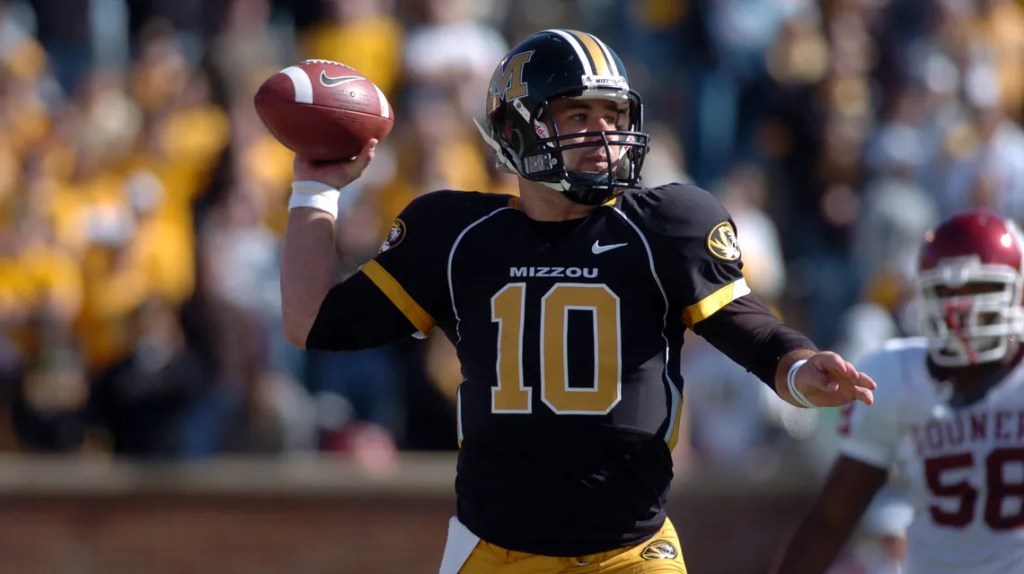
Like the rest of his team, Daniel was chasing history in 2007. Missouri had never had a Heisman Trophy winner. Prior to the matchup with Kansas, Daniel was a 69% passer, with 3,590 yards, 30 TDs, and only 9 INTs. Although Florida QB Tim Tebow was the favorite for the award, Daniel would be front and center on the national stage in Kansas City against the Jayhawks. Everything was left on the table for Daniel and the Tigers. A rematch against Oklahoma in the Big 12 title, and more importantly, a chance to play for the BCS championship.


Leave a comment